Will All Li-ion Battery Chemistries Be Recycled
Lithium-ion batteries are used for a range of applications, including consumer electronic and portable devices, battery energy storage systems and electric vehicles. The demand for Li-ion batteries has continued to increase significantly over the last decade.
Lithium-ion batteries are used for a range of applications, including consumer electronic and portable devices, battery energy storage systems and electric vehicles. The demand for Li-ion batteries has continued to increase significantly over the last decade. Demand in these three sectors reached 50 GWh in 2015, compared with 4.1 TWh of demand forecast in 2030, with EVs accounting for approximately 85% of this.
Increasing demand for Li-ion batteries has also increased demand for the materials used to manufacture them, including lithium, cobalt and nickel. Potential supply bottlenecks coming in the medium term for these materials have put an emphasis on recovering them via Li-ion battery recycling. Material shortages have also caused spikes in material costs and can make this difficult to manage for a battery manufacturer. By sourcing materials from recycling, battery manufacturers will be able to domesticate material supply while shielding themselves from fluctuating material prices and shortages. Stakeholders in Li-ion end-of-life management and battery manufacturing will be keen to understand what technologies will be used in recycling, the usable products and the Li-ion chemistries that will generate the most revenue from recycling.
Three key technologies used in Li-ion battery recycling
Mechanical, hydrometallurgical and pyrometallurgical recycling technologies are those typically used in Li-ion battery recycling. Pyrometallurgy occurs in a shaft furnace, which operates at high temperatures. Electrolyte is burned off, and other organics (binder material, separators) decompose and cannot be recovered. The key intermediary products are a mixed-metal alloy, as well as a slag stream, containing lithium and aluminum. These would require further processing with hydrometallurgy to obtain more refined products. Pyrometallurgical recycling is an energy-intensive process and typically has lower recycling efficiencies than hydrometallurgical recycling. Moreover, the scrubbing of off-gases from the process is typically required, too.
If choosing to recycle batteries via a hydrometallurgical route, a recycler would first have to obtain a Li-ion battery or cathode manufacturing scrap from a cell production facility. A battery would have to be discharged and disassembled to obtain cells. These are then mechanically crushed to form a fine powder known as black mass. This can then be fed into a hydrometallurgical process, which typically uses chemical reagents and high volumes of water to selectively extract valuable metals in the form of battery-grade metal salts. For instance, this could be lithium carbonate, nickel sulfate, etc. These can be further processed to create a precursor for cathode active material for new Li-ion batteries.
As a result, hydrometallurgical recycling is a technology that offers a greater value proposition than just pyrometallurgical recycling alone while also being a lower-energy and higher-efficiency process. For these reasons, global hydrometallurgical recycling capacity is expected to expand the most (see Figure 1) alongside mechanical recycling capacity, as this is required to produce black mass, the feedstock for hydrometallurgical recycling. Most hydrometallurgical recycling capacity exists in the Asia-Pacific region currently, though recyclers in North America and Europe have started to, or are planning to, construct commercial-scale hydrometallurgical Li-ion battery recycling plants.
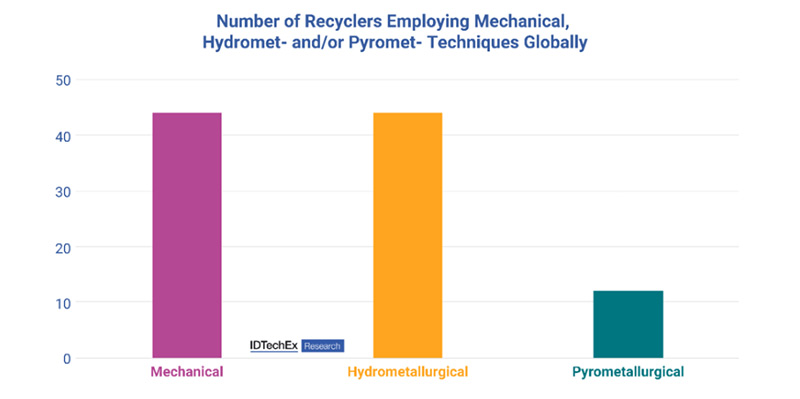
Figure 1: Number of recyclers employing different techniques globally in 2022 (Source: IDTechEx)
Which chemistries will be more economic to recycle?
Recyclers will be keen to extract as much embedded value in Li-ion batteries as possible. Figure 2 highlights the value in different Li-ion battery chemistries (using 2023 material prices). Clearly, lithium-cobalt (LCO) batteries contain the most value due to their high cobalt content. These batteries are mostly used in consumer electronics batteries, and historically, these have been more difficult to collect than EV or stationary storage batteries. This is because consumers have little incentive to do this. In fact, the European Commission plans to assess the feasibility of deposit schemes for portable batteries by the end of 2023, which, if possible, could be beneficial for both consumers and recyclers. Nickel-manganese-cobalt oxide (NMC) and nickel-cobalt-aluminium oxide (NCA) batteries also have a high embedded value and are thus likely to be recycled. Many EV batteries use these chemistries, as they exhibit higher energy densities than lithium-iron-phosphate (LFP) batteries. This is important, as this facilitates a greater EV driving range.
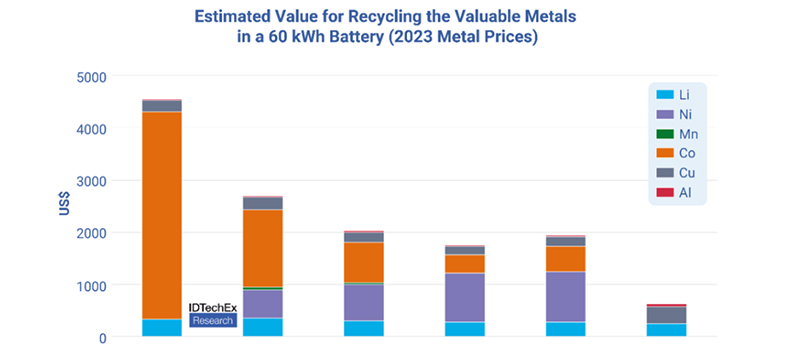
Figure 2: Estimated value for recycling different battery chemistries (Source: IDTechEx)
LFP batteries, however, are less valuable, and this is primarily due to the lack of cobalt and nickel in the cathode. Moreover, battery manufacturers may have to pay a gate fee to cover the costs of recycling. LFP batteries generally have a longer lifetime than NMC/NCA batteries and are inherently safer, so LFP EV batteries are likely to be more suited for second-life applications, such as for stationary energy storage.
This is not to say that LFP batteries will not be recycled. With lithium being identified as a critical mineral in the EU, battery manufacturers will still be looking to obtain lithium to meet minimum recycled content targets proposed in the EU battery regulation. Eight years after entry into force of the regulation, new industrial and EV batteries must contain 6% recycled lithium. Therefore, LFP recycling could be more widely adopted in the EU. Also, LFP batteries have a high copper content compared with other chemistries, and this is an important material for battery manufacturing. Copper has also been labeled as a strategically important material by the European Commission and may be subject to supply constraints in the future.
Obtaining copper and aluminum foils is a relatively simple step in recycling pre-processing steps. This can be achieved through means like solvent dissolution, which removes anode and cathode powders from the current collector (i.e., foils). However, it may therefore be less economically feasible to establish subsequent hydrometallurgical processing steps, only to obtain lithium from LFP batteries in the form of battery-grade salts. Ultimately, it would be more economical to perform these steps for NMC or NCA batteries, where a variety of metal salts of overall higher value could be obtained.
Outlook
Li-ion battery recycling will be key for battery manufacturers looking to obtain materials for new battery manufacturing domestically while shielding themselves from fluctuating material prices and potential supply bottlenecks. This will be a booming market, and we expect 23.8 million tons of Li-ion batteries will be recycled in 2043. Mechanical and hydrometallurgical recycling techniques are likely to see the most expansion globally due to better process efficiencies, reduced energy requirements and more valuable products created in the form of battery-grade metal salts. NMC and NCA Li-ion batteries are those most likely to be recycled in the long term due to the greater value embedded within them from a materials perspective, compared with LFP batteries.
From:EE Times Europe: Will All Li-ion Battery Chemistries Be Recycled?